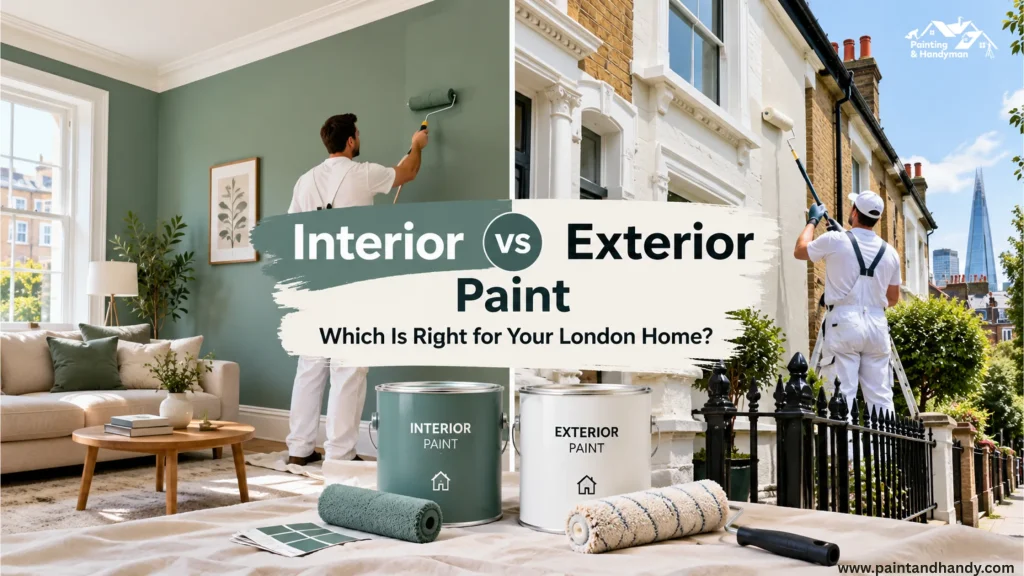
Are you planning to repaint your London home but not sure whether you need interior or exterior paint?
The simple answer is: interior paint is made for indoor walls and surfaces, while exterior paint is designed to handle outdoor exposure such as rain, temperature changes and weathering. They are not interchangeable.
Choosing the right paint is only part of the job. The surface, moisture level, existing coating, location and condition of the wall also affect how well the finished paintwork performs.
Interior vs Exterior Paint: What Is the Difference?
Interior and exterior paints may look similar in the tin, but they are formulated for different environments.
Interior paint is designed for rooms where surfaces are protected from direct weather exposure. It usually focuses on appearance, cleanability, durability and suitability for indoor air conditions.
Exterior paint needs to cope with conditions that indoor paint does not face, including rain, sunlight, temperature changes and moisture from the outside environment.
Quick comparison
| Feature | Interior Paint | Exterior Paint |
| Main use | Walls, ceilings, doors and other indoor surfaces | External walls, masonry, render and suitable outdoor surfaces |
| Weather exposure | Low | High |
| Rain resistance | Not designed for prolonged outdoor exposure | Designed for outdoor conditions |
| UV exposure | Limited | Formulated to cope with sunlight |
| Moisture | Depends on the room and product | Designed for exterior moisture exposure |
| Typical locations | Bedrooms, living rooms, hallways, ceilings | External walls, masonry and exterior woodwork |
| Best choice | Indoor surfaces | Outdoor surfaces |
The exact performance depends on the paint product, substrate and manufacturer’s instructions.
Why Can’t You Use Interior Paint Outside?
Using ordinary interior paint on an exterior surface may seem like a quick way to save money, but the coating is being asked to work in conditions it was not designed for.
Outdoor surfaces can experience:
- Rain and wind
- Direct sunlight
- Repeated wetting and drying
- Seasonal temperature changes
- Surface moisture
- Dirt and pollution
Over time, these conditions can contribute to peeling, fading, cracking or loss of adhesion when an unsuitable coating is used.
Exterior paint systems are designed specifically for these demands. The correct product also depends on what you are painting, such as masonry, render, timber or metal.
Tip: Don’t choose paint only by colour.
Two tins can contain almost identical-looking shades while being intended for completely different surfaces. Always check whether the product is suitable for the location and substrate before buying it.
What Makes Exterior Paint Different?
The biggest difference is the environment in which the coating has to perform.
An exterior coating needs to tolerate outdoor exposure while remaining properly bonded to the surface. The paint system may also need to allow the substrate to deal with moisture appropriately.
For a London property, this matters because external walls are exposed to changing weather throughout the year.
The Met Office explains that humidity is closely linked with rainfall because water vapour in the atmosphere can condense and contribute to precipitation.
That does not mean there is one single “best paint for London weather”. The correct choice depends on the wall material, exposure, condition and manufacturer’s specification.
What Paint Should You Use Inside a London Home?
For interior walls, choose a paint specifically labelled for indoor use and suitable for the room.
Living rooms and bedrooms
For most living rooms and bedrooms, homeowners often prioritise:
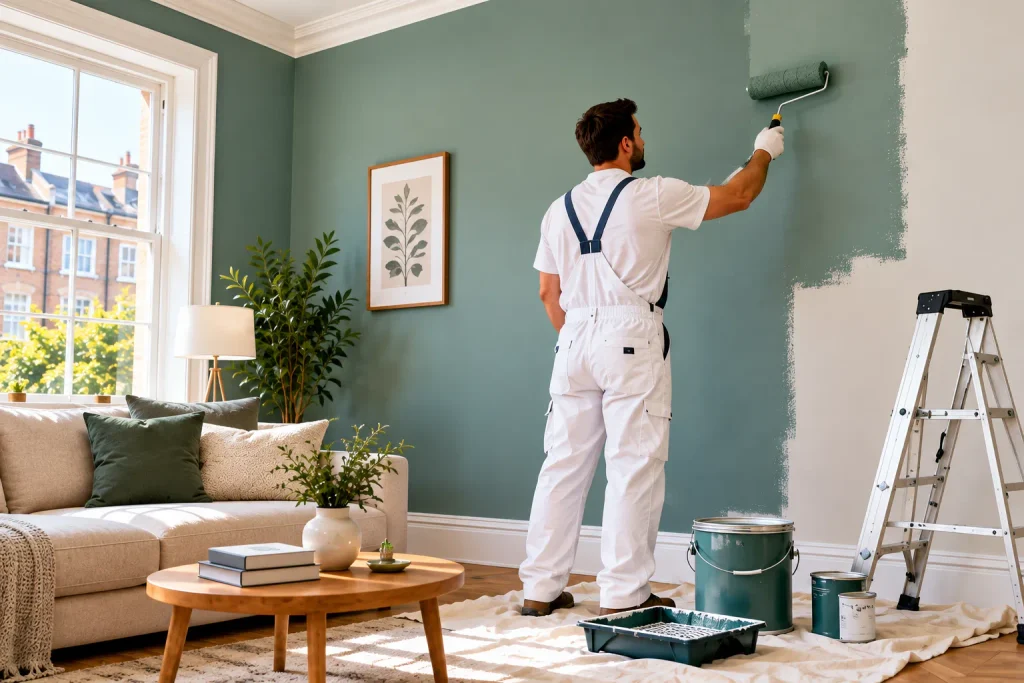
- A suitable matt or low-sheen finish
- Easy cleaning
- Good coverage
- The desired colour and appearance
- Suitability for the existing wall surface
Matt finishes can help reduce the appearance of minor surface imperfections because they reflect less light.
Hallways and high-traffic areas
Hallways can need a more washable finish because they are touched and marked more often than some other rooms.
Think about:
- How frequently the wall needs cleaning
- Children or pets in the home
- Natural and artificial lighting
- Existing wall condition
- Desired finish
Kitchens and bathrooms
Kitchens and bathrooms have different moisture conditions from bedrooms and living rooms.
Choose a product specifically suitable for the room and follow the manufacturer’s guidance about ventilation, preparation and application.
If your wall already has mould, damp staining or bubbling paint, do not simply cover it with a new coat.
Paint & Handy’s existing guidance explains why damp, mould, poor surface preparation and damaged plaster can cause paintwork to fail.
Is Low-VOC Paint Better for Interior Walls?
When choosing interior paint, it is sensible to consider the product’s VOC information.
VOC stands for volatile organic compounds. Some paints and coatings can release VOCs as they are applied and dry.
The UK Health and Safety Executive advises that paints and coatings can contain substances that create health risks if exposure is not properly controlled. It also recommends paying attention to product labels and VOC information.
UK local-authority guidance also recommends considering low-VOC or water-based paints and keeping indoor spaces properly ventilated when using products that can release pollutants.
For an indoor painting project, check:
- VOC information on the product
- Manufacturer’s application instructions
- Recommended ventilation
- Drying times
- Suitability for the room
There is no need to choose paint based on VOC claims alone. The product still needs to be suitable for the surface and room.
What Is the Best Paint for London Weather?
There is no single paint that is automatically the best for every London property.
For exterior work, the right product should be selected according to:
- The surface — masonry, render, brick, timber or another material.
- Existing coating — the old paint may affect preparation and compatibility.
- Exposure — a sheltered wall has different demands from a fully exposed elevation.
- Moisture — signs of damp or water penetration need investigation first.
- Manufacturer guidance — application conditions and product suitability matter.
- Surface preparation — even good exterior paint can fail when applied over a weak or contaminated surface.
The goal is not simply to find the strongest paint. It is to choose a suitable paint system for the actual building.
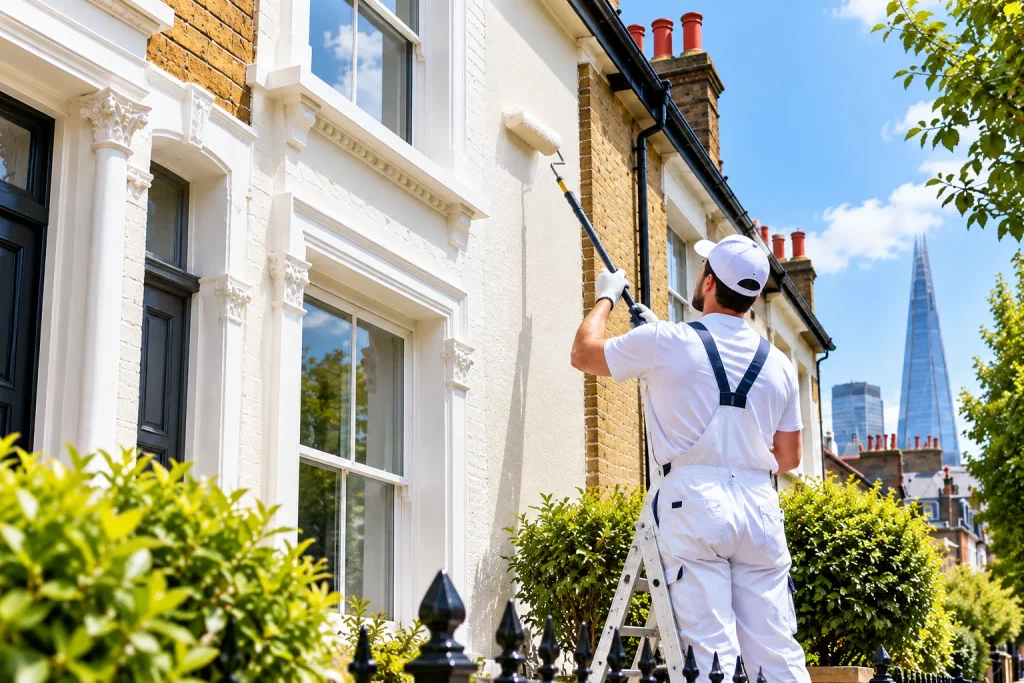
Why London Homes Need Extra Care Before Painting
London contains a large number of older properties.
According to the London Assembly Research Unit’s 2024 report, 27.6% of London’s homes were built before 1919 and another 22.3% were built between 1919 and 1944. That means around half of London’s homes were built before 1945. The underlying data came from the English Housing Survey 2021.
Older properties can have surfaces that need more preparation before painting.
Before starting, check for:
- Cracked plaster
- Loose or flaky paint
- Damp patches
- Mould
- Water staining
- Uneven surfaces
- Old repairs
- Damaged render
- Failed exterior coatings
A fresh coat of paint cannot fix a damaged surface underneath it.
If you are unsure whether a crack needs repair before decorating, Paint & Handy’s guide to plaster wall cracks explains the different types and when further assessment may be needed.
Interior vs Exterior Paint: Which One Should You Choose?
Use this simple rule:
Choose interior paint when:
- You are painting an indoor wall or ceiling.
- The surface is protected from outdoor weather.
- You need a finish suited to a living space.
- The product is suitable for the room and substrate.
Choose exterior paint when:
- You are painting an outside wall.
- The surface is exposed to rain and weather.
- You are painting suitable exterior masonry, render or woodwork.
- The product is specifically rated for outdoor use.
What if the surface is between the two?
Some areas need more careful consideration.
For example, an enclosed porch, exterior door, window surround or sheltered entrance may have different requirements from a normal indoor wall.
In these cases, check the surface material and manufacturer’s instructions rather than choosing paint based only on whether the area feels “inside” or “outside”.
What Happens If You Use the Wrong Paint?
Using an unsuitable product can create problems such as:
- Peeling
- Flaking
- Poor adhesion
- Uneven coverage
- Bubbling
- Premature fading
- Cracking
- Difficult cleaning
However, the paint itself is not always the cause.
Poor preparation, damp, unstable plaster, contamination, incompatible old coatings and incorrect application can also lead to failure.
That is why professional painting usually starts with surface assessment and preparation, rather than opening a tin and immediately applying the first coat.
How to Prepare Your London Home Before Painting
Whether you are painting inside or outside, preparation makes a major difference.
Step 1: Inspect the surface
Look for cracks, damp, mould, loose paint, holes and damaged areas.
Step 2: Identify the surface
Work out whether you are painting plaster, drywall, masonry, render, timber or another material.
Step 3: Remove loose material
Flaking or unstable paint should not simply be covered with a new coating.
Step 4: Repair defects
Fill suitable cracks and holes and repair damaged areas before decorating.
Step 5: Clean the surface
Remove dust, dirt, grease, mould or other contamination as appropriate for the surface.
Step 6: Allow moisture problems to dry
Do not paint over active damp or water damage.
Step 7: Use primer where required
Some surfaces and repairs need a suitable primer before the finishing coats.
Step 8: Apply the correct paint
Follow the manufacturer’s instructions for coats, drying times and application conditions.
Paint & Handy provides painting and decorating services covering interior and exterior work, along with plastering and wall repairs.
Common Interior and Exterior Painting Mistakes
1. Choosing paint by colour alone
A colour that looks perfect on a sample is not enough. Check whether the product is designed for the surface and location.
2. Painting over damp
Moisture needs to be dealt with before decoration.
3. Skipping surface preparation
Loose paint, dust and damaged plaster can affect the new coating.
4. Using interior paint outdoors
Interior paint is not designed to deal with normal exterior exposure.
5. Ignoring the existing coating
Old paint can affect adhesion and may need preparation before a new system is applied.
6. Rushing drying time
Paint needs the conditions and drying time specified by the manufacturer.
7. Assuming every London home needs the same paint
A Victorian terrace, modern flat and rendered semi-detached house may have very different surfaces and painting requirements.
Interior vs Exterior Paint: A Simple Decision Guide
If you are still unsure, ask these five questions:
1. Is the surface inside or outside?
This is the first decision.
2. What material am I painting?
Plaster, masonry, render, timber and metal may require different products.
3. Is there moisture or damp?
If yes, investigate the cause before painting.
4. What condition is the existing coating in?
Peeling or unstable paint needs preparation.
5. Does the product specifically say it is suitable?
Always follow the manufacturer’s instructions.
If you can answer these five questions, you can usually narrow down the type of paint system you need.
When Should You Hire a Professional Painter in London?
DIY painting can work well for small, straightforward jobs. Professional help becomes more useful when the project involves:
- Large areas
- High ceilings
- Exterior walls
- Difficult access
- Extensive preparation
- Damaged plaster
- Persistent damp
- Multiple surfaces
- A full property renovation
- Rental property preparation
Paint & Handy provides painting and decorating services across London, including interior walls, ceilings, doors, coving and skirting, as well as exterior masonry, rendering and woodwork painting.
The company also works with homeowners, landlords and businesses across London.
Conclusion: Choose the Paint for the Surface, Not Just the Colour
So, interior vs exterior paint is not really about choosing the better type of paint. It is about choosing the correct product for the job.
Interior paint is made for indoor surfaces. Exterior paint is designed to handle outdoor exposure. But the right choice also depends on the surface, existing coating, moisture, preparation and product instructions.
For London homeowners, landlords and property renovators, checking these details before painting can help avoid unnecessary peeling, cracking and repeat work.
If your London property needs interior or exterior painting, Paint & Handy provides professional painting and decorating services, including surface preparation, interior painting, exterior painting and related wall repairs.
Planning a painting project? Contact Paint & Handy to discuss your requirements and request a quote.
Frequently Asked Questions
1. Can I use exterior paint inside my house?
Not automatically. Exterior products are designed for outdoor conditions, so they should only be used indoors when the manufacturer specifically states that the product is suitable for interior use.
2. What is the main difference between exterior and interior paint?
The main difference is the environment they are designed for. Interior paint is intended for protected indoor surfaces, while exterior paint is formulated for outdoor exposure such as weather and temperature changes.
3. Can I use interior paint on an exterior wall?
It is generally not the right choice. Interior paint is not designed for prolonged outdoor exposure, so use a product specifically suitable for the exterior surface instead.
4. What is the best paint for London weather?
There is no single product that suits every London property. The correct exterior paint depends on the substrate, existing coating, exposure, moisture conditions and manufacturer’s recommendations.
5. Should I use low-VOC paint inside my London home?
Low-VOC or water-based options can be considered for indoor projects, particularly where ventilation is limited. Always check the product label and follow the manufacturer’s ventilation and application instructions. UK guidance recommends considering low-VOC alternatives.
6. Can I paint over damp or mould?
No. The cause of the moisture should be identified and addressed before repainting. Painting over an active damp problem can lead to peeling, bubbling and recurring mould.
7. Do older London homes need special preparation before painting?
They may. Older properties can have cracked plaster, previous repairs, loose coatings, damp or other surface issues. London’s housing stock includes a large proportion of pre-1945 homes, so inspecting the surface before painting is particularly important.
8. How do I know whether I need interior or exterior paint?
Start with the location, then check the surface material and condition. Choose a product specifically rated for that location and substrate, and follow the manufacturer’s instructions.
