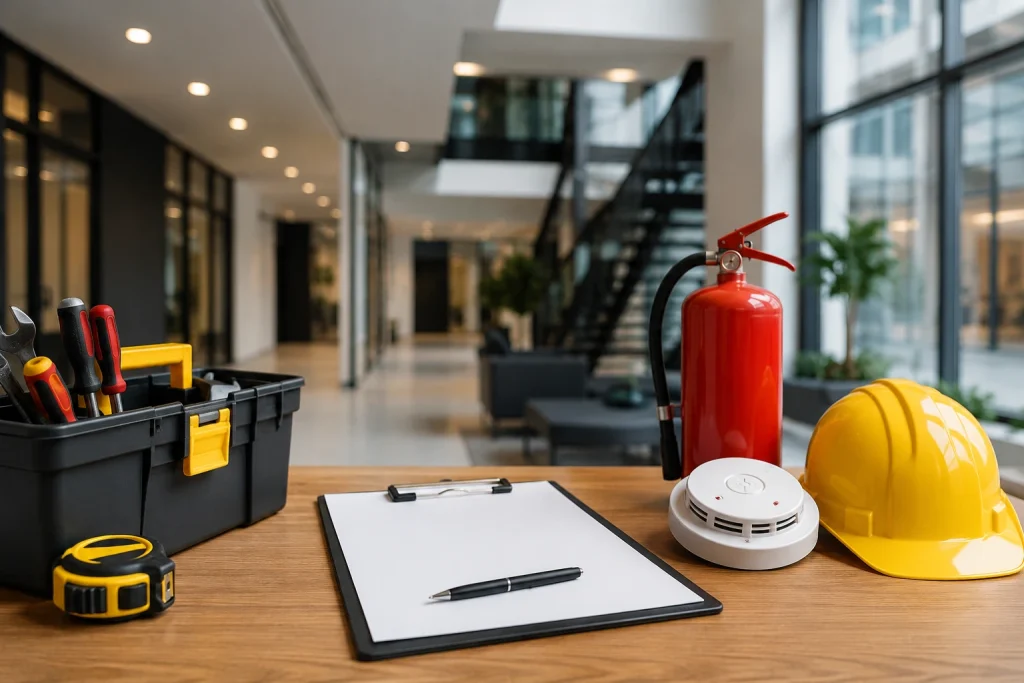
Managing a commercial property in London isn’t just about keeping things looking good, it’s about staying legally compliant and avoiding costly risks. This 2026 commercial property maintenance checklist covers everything you need to keep your office or shop safe, compliant, and running smoothly.
What Should a 2026 Maintenance Checklist Include?
A complete commercial maintenance checklist includes electrical testing, fire risk management, water hygiene, gas safety, and cosmetic upkeep. Each category has its own inspection interval, its own responsible party, and its own paper trail. Property managers in Central London, Southwark, Dulwich, and Kidbrooke typically assign these duties to a facilities manager or a nominated “responsible person.”
The five categories are:
- Electrical installation testing (EICR)
- Fire risk assessment and equipment servicing
- Legionella and water system management
- Gas safety inspection
- Interior and structural maintenance
Every item on this list connects to a specific piece of UK legislation. Skipping any one of them creates a compliance gap, not just a cosmetic one.
How Often Does A London Office Need An EICR?
A London office needs an Electrical Installation Condition Report (EICR) at intervals set by risk, not by a single fixed law. The Electricity at Work Regulations 1989 places a legal duty on employers to keep electrical systems safe, without naming an exact testing interval. The Institution of Engineering and Technology (IET) fills that gap through BS 7671, the UK Wiring Regulations, which recommend a maximum five-year interval for standard offices and shops.
High-risk environments need shorter cycles:
- Standard offices and retail units: every 5 years
- Restaurants and commercial kitchens: every 3 years
- Construction sites and temporary installations: every 3 months
- Swimming pools and high-hazard settings: annually
Many City of London and West End office leases already write the five-year EICR into tenant obligations. A qualified electrician registered with a body such as NICEIC should carry out the inspection.
What Are The Fire Safety Duties Under The 2005 Order?
The Regulatory Reform (Fire Safety) Order 2005 makes one named person legally accountable for fire safety in every London office and shop. This person, called the “responsible person,” is usually the employer, owner, or managing agent with control of the premises. The Order replaced the old fire certificate system with an ongoing risk-based duty.
Responsible persons must:
- Carry out a written fire risk assessment (mandatory if five or more people are employed)
- Review the assessment at least once a year, or after any layout change
- Maintain fire doors, alarms, extinguishers, and emergency lighting
- Keep escape routes clear and clearly signed
- Train staff on fire procedures and evacuation
Fire and rescue services enforce the Order and can issue improvement notices, prohibition notices, or prosecute for non-compliance.
How Should Businesses Manage Legionella Risk?
Businesses manage Legionella risk by identifying water systems, assessing hazards, and reviewing that assessment on a set cycle. The Health and Safety Executive’s Approved Code of Practice, ACOP L8, sets out this duty under the Control of Substances Hazardous to Health Regulations 2002 (COSHH). Any office or shop with cold water tanks, hot water cylinders, or infrequently used taps falls within scope.
Core Legionella duties include:
- Appointing a competent person to hold responsibility for water safety
- Producing a written scheme for controlling risk
- Reviewing the risk assessment at least every two years, or sooner after any system change
- Flushing infrequently used outlets weekly
- Recording water temperatures at hot and cold outlets
Shared office buildings with communal kitchens or shower facilities carry a higher risk profile and often need more frequent checks.
What Gas Safety Checks Do Shops And Offices Need?
Shops and offices with gas appliances need an annual safety check from a Gas Safe registered engineer. This duty comes from the Gas Safety (Installation and Use) Regulations 1998, which apply to any commercial premises using gas boilers, water heaters, or catering appliances. Engineers must hold current Gas Safe Register certification for the specific appliance category, since a domestic-only qualification does not cover commercial kitchen equipment.
The annual check confirms:
- Correct appliance ventilation
- Safe flue operation
- No gas leaks at joints or connections
- Functioning safety cut-off devices
Landlords who let commercial units with gas supply must also keep gas safety records for at least two years and provide copies to tenants on request.
What Interior Maintenance Keeps A Shop Or Office Presentable?
Interior maintenance keeps a London shop or office presentable through scheduled painting, flooring checks, and fixture repairs. First impressions affect footfall in retail units and client confidence in office reception areas. A five-year repaint cycle suits most commercial interiors, though high-traffic retail frontages in areas like Westcombe Park and Charlton often need touch-ups every 12 to 18 months.
Regular interior tasks include:
- Repainting walls, skirting, and trim with durable trade paints
- Checking flooring, carpet tiles, and grout for wear
- Servicing blinds, door closers, and internal signage
- Fixing loose sockets, dimmed lighting, and squeaking hinges
Businesses that want a single point of contact for these tasks often turn to a specialist office and property maintenance service that handles painting, electrics, and general repairs under one visit, reducing disruption to trading hours.
How Can Businesses Avoid Common Compliance Gaps?
Businesses avoid compliance gaps by tracking every certificate expiry date in one shared calendar. The most frequent gap is a lapsed EICR discovered only during an insurance claim or lease renewal, when it is too late to arrange a routine inspection.
Common oversights to close:
- Fire risk assessments left unreviewed after a layout change
- Legionella logs missing weekly flushing records
- Gas safety certificates stored only on paper, with no digital backup
- PAT testing skipped for staff-owned equipment brought into the office
- Painting and repair requests logged but never actioned before a client visit
A single compliance calendar, shared between the responsible person and any contracted maintenance provider, closes most of these gaps before they become violations.
Final Thoughts
A 2026 commercial maintenance checklist protects staff, tenants, and customers while keeping a London office or shop legally compliant. Electrical, fire, water, and gas duties sit alongside everyday cosmetic upkeep, and both categories need equal attention. Businesses that treat maintenance as a scheduled routine, rather than a reactive fix, avoid the disruption of failed inspections and last-minute repairs.
For offices and shops across North, East, West, and Central London, including Dulwich, Westcombe Park, Kidbrooke, and Charlton, looking for a dependable partner to manage ongoing repairs and presentation standards, Paint and Handy offers experienced tradespeople who understand the pace of a working commercial environment.
