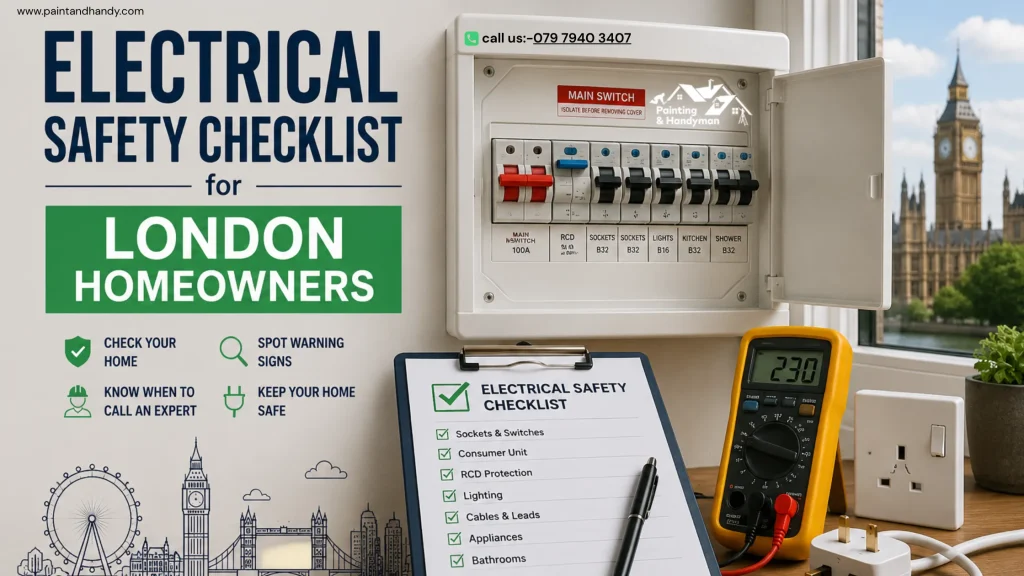
Are you confident that the electrical system in your London home is safe?
You may check your lights, sockets and appliances every day without thinking about their safety. But some electrical faults are hidden inside walls, sockets, switches and consumer units.
A simple electrical safety check can help you spot warning signs early and know when a qualified electrician should inspect the installation.
Quick Answer
A good electrical safety check should cover sockets, switches, visible cables, lighting, the consumer unit, rd protection, extension leads and household appliances. If you notice burning smells, scorch marks, buzzing, repeated breaker trips, damaged cables or electric shocks, stop using the affected equipment or circuit if it is safe to do so and contact a qualified electrician.
For London homeowners, extra care can be useful in older properties where electrical installations may have been altered or extended over many years.
Why Electrical Safety Matters in London Homes
Electricity makes modern homes convenient, but faults can create fire and shock risks when equipment or installations are damaged, overloaded or poorly maintained.
Electrical Safety First reports that 13,537 accidental electrical dwelling fires occurred in England in 2024/25.
The organisation also analysed government fire data and found that 1,140 accidental electrical fires involving common household white goods occurred in England in 2024, equal to about three fires a day. Greater London recorded 186 of these incidents.
These figures do not mean that electrical problems are common in every London property. They do show why basic checks, sensible appliance use and professional inspection matter.
London also has a large mix of property types, from Victorian terraces and Edwardian homes to converted flats and newer developments. The age of a building alone does not tell you whether its electrics are unsafe. The condition, history and alterations to the installation matter more.
Electrical Safety Checklist for London Homeowners
Use this quick checklist as a visual review of your home:
| Area | What to Check |
| Sockets | Cracks, heat, looseness, scorch marks |
| Switches | Damage, unusual sounds or heat |
| Cables | Fraying, exposed wires or damage |
| Lighting | Flickering, buzzing or loose fittings |
| Consumer unit | Damage, unusual sounds or repeated trips |
| RCD | Test button and operation |
| Extension leads | Overloading, damage and poor positioning |
| Appliances | Recalls, damaged plugs and cables |
| Bathrooms | Safe positioning of electrical equipment |
| Outdoor areas | Damaged cables, sockets and lighting |
| Older wiring | Signs of age or previous alterations |
| Certificates | Records from previous electrical work |
This checklist is for basic observation, not electrical repair. Homeowners should not remove socket covers, open a consumer unit or work on fixed wiring as part of a routine DIY check.
1. Check Your Electrical Sockets
Sockets are among the easiest electrical components to inspect because they are visible and used frequently.
Look for:
- Cracked or damaged faceplates
- Loose sockets
- Brown or black marks
- Melted plastic
- Signs of overheating
- Sparks when plugging in equipment
- Unusual smells
- Plugs that feel unusually hot
A socket that feels hot during normal use deserves attention. Heat can indicate an overloaded circuit, poor connection, damaged equipment or another electrical fault.
What should you do?
If a socket shows obvious damage, avoid using it and arrange a professional inspection.
Do not try to tighten internal connections or replace damaged wiring yourself unless you have the required competence and certification.
2. Inspect Switches and Light Fittings
Walk through each room and turn lights on and off normally.
Watch for:
- Flickering
- Delayed switching
- Buzzing
- Crackling
- Burning smells
- Loose switches
- Discoloured plates
- Heat around switches
One faulty bulb does not automatically mean there is a problem with the home’s wiring. However, repeated flickering or unusual sounds should not be ignored.
If the issue continues after changing a bulb, ask a qualified electrician to investigate.
London-specific tip
Period homes may have had several rounds of renovation. A room that looks original from the outside may contain electrical work from different periods. If you have recently bought an older London property and do not know when the electrical installation was last inspected, a professional assessment can give you a clearer picture.
3. Look at Visible Electrical Cables
Never ignore visibly damaged cables.
Check accessible cables connected to:
- Lamps
- Appliances
- Extension leads
- Outdoor equipment
- Computers
- TVs
- Chargers
Look for:
- Cuts
- Fraying
- Crushed sections
- Exposed conductors
- Heat damage
- Loose plugs
Keep cables away from heat, water and areas where they can be trapped under furniture.
Do not use tape as a permanent repair for damaged electrical cables. Replace damaged equipment or have it checked by a qualified professional.
4. Check Your Consumer Unit
The consumer unit is the electrical panel that contains protective devices for your home’s circuits.
It may contain:
- Circuit breakers
- RCDs
- RCBOs
- Main switch
You do not need to open the consumer unit to carry out a basic home safety check.
Instead, look for visible signs such as:
- Physical damage
- Burning or scorch marks
- Unusual smells
- Buzzing
- Excessive heat
- Repeated circuit trips
If the consumer unit repeatedly trips, do not keep resetting it without finding out why.
A circuit breaker can trip because of an overloaded circuit, a faulty appliance, damaged wiring or another fault. A qualified electrician can test the circuit and identify the cause.
5. Understand rd Protection
An rd, or Residual Current Device, is designed to reduce the risk of serious electric shock by disconnecting electricity when it detects an imbalance in current.
rd protection is an important part of electrical safety in modern homes.
If your consumer unit has an rd with a test button, the manufacturer’s instructions should be followed for testing it.
What if the rd trips?
If an rd trips occasionally, there may be a fault with an appliance or circuit.
If it keeps tripping, don’t repeatedly reset it and continue using the system as normal. Disconnect appliances where it is safe to do so and seek professional help if the cause is not obvious.
Electrical Safety First advises homeowners to arrange professional inspection when they notice warning signs such as burn marks, buzzing or crackling, blown fuses or repeated circuit-breaker trips.
Safety Tip: Never investigate a suspected electrical fault by opening the consumer unit or removing socket and switch covers.
If you can see burning, exposed wiring, melted plastic, sparks or other signs of serious damage, keep people away from the affected area and contact a qualified electrician. If there is an immediate fire or life-threatening emergency, contact the appropriate emergency service.
6. Avoid Overloading Sockets and Extension Leads
Modern homes use more electrical equipment than many older electrical installations were originally designed around.
Common high-demand appliances include:
- Electric heaters
- Washing machines
- Tumble dryers
- Dishwashers
- Ovens
- Kettles
- Microwaves
Avoid connecting several high-power appliances to one extension lead or adapter.
Also check that extension leads are:
- Undamaged
- Fully unwound when required by the manufacturer’s instructions
- Kept away from water
- Positioned where they will not be crushed
- Used within their rated capacity
Do not connect one extension lead or multiway adapter into another simply to create more outlets.
If you regularly need several extension leads in one room, consider asking an electrician whether additional fixed sockets would be a better solution.
7. Check Household Appliances
Electrical safety is not only about fixed wiring.
Before using an appliance, inspect its:
- Plug
- Cable
- Switch
- Housing
- Ventilation openings
Do not use an appliance with a damaged cable, cracked casing, exposed wiring or signs of overheating.
Pay particular attention to appliances that generate heat or operate for long periods, including washing machines, tumble dryers, dishwashers, heaters and cooking equipment.
Electrical Safety First reported 1,140 accidental electrical fires involving common white goods in England in 2024, with Greater London recording 186 incidents.
The same organisation also reported in 2026 that 7% of UK adults surveyed said they never test their smoke alarm, equivalent to around four million adults.
Electrical safety and fire safety therefore work together. Test your smoke alarms regularly and deal with electrical warning signs promptly.
8. Take Extra Care in Kitchens and Bathrooms
Kitchens and bathrooms deserve particular attention because electricity is used near water and moisture.
Kitchen checks
Look at:
- Appliance cables
- Sockets
- Cooker connections
- Extractor fans
- Under-counter equipment
- Signs of water near electrical fittings
Keep electrical equipment and cables away from sinks and areas where water can splash.
Bathroom checks
Avoid bringing portable electrical equipment into areas where it can come into contact with water.
Fixed electrical work in locations such as bathrooms and shower areas is subject to specific Building Regulations requirements. Part P applies to electrical installations in dwellings, and some work in kitchens, bathrooms and other special locations can be notifiable.
If you are planning electrical changes in a bathroom, use a competent electrical professional who understands the relevant requirements.
9. Inspect Outdoor Electrical Equipment
Garden lighting, outdoor sockets and other external electrical equipment are exposed to rain, moisture and weather changes.
Check visible equipment for:
- Cracked covers
- Damaged cables
- Loose fittings
- Water ingress
- Corrosion
- Unusual operation
Do not use outdoor electrical equipment that appears damaged.
New outdoor electrical installations may also fall under Building Regulations requirements. If you are planning garden lighting, an outdoor socket or a new electrical supply to a shed, discuss the work with a qualified electrician before starting.
10. Pay Attention to Older London Homes
Older properties are not automatically unsafe.
However, a Victorian terrace, Edwardian house or older converted flat may have undergone several electrical alterations over its lifetime.
Potential reasons for an inspection include:
- Unknown electrical history
- Previous renovations
- Extensions
- Additional circuits
- Older consumer units
- Signs of damaged wiring
- Repeated electrical faults
- Recent property purchase
Electrical Safety First states that there is no single age at which a property automatically needs rewiring. The condition of the installation matters.
So avoid assuming that an old property needs a full rewire simply because of its age.
A professional inspection can establish what actually needs attention.
11. Know When an EICR Makes Sense
An Electrical Installation Condition Report (EICR) is a formal inspection and testing report for an electrical installation.
It checks the condition of the fixed electrical installation and identifies defects, safety concerns and recommended work.
Homeowners
For an owner-occupied home, an EICR is not a general legal requirement. Electrical Safety First recommends periodic inspection and testing at least every 10 years for an owner-occupied home.
It can be particularly useful when:
- You have bought an older property.
- You do not know when the electrics were last checked.
- You are planning major renovation work.
- The property has undergone several alterations.
- You notice recurring electrical faults.
- You want documented information about the condition of the installation.
Landlords
The position is different for rented homes in England.
Under the current Electrical Safety Standards guidance, landlords must have the electrical installation inspected and tested by a qualified person at least every five years. A copy of the report must be provided to a new tenant before occupation and to an existing tenant within 28 days of the inspection and test.
This distinction matters because advice written for landlords should not be presented as a legal requirement for homeowners.
12. Understand Part P Before Starting Electrical Work
Part P is part of the Building Regulations in England and relates to electrical safety in dwellings.
The rules do not mean that every minor electrical task requires a Building Regulations application. The requirements depend on the type and location of the work.
For example, certain work involving:
- New circuits
- Consumer unit replacement
- Electrical installations in kitchens
- Electrical installations around baths or showers
- Some outdoor electrical installations
can have notification or certification requirements.
Using an electrician registered with an authorised Competent Person Scheme can make the certification process simpler. GOV.UK provides a route for finding registered competent people for building work.
Before starting electrical alterations, ask the electrician what certification or Building Regulations process applies to the planned work.
13. Keep Records of Electrical Work
If electrical work has been carried out at your property, keep the relevant documentation.
Depending on the work, this may include:
- Electrical Installation Certificate
- Minor Works Certificate
- EICR
- Building Regulations compliance certificate
- Product documentation
- Warranty information
Good records can help you understand the history of the installation and may be useful when carrying out future work or selling the property.
GOV.UK notes that certificates from competent-person work can also provide evidence of Building Regulations compliance and may appear in property records used during a sale.
14. When Should You Call an Electrician?
Some electrical issues need professional attention rather than another DIY attempt.
Arrange a qualified electrician if you notice:
- Repeated circuit-breaker trips
- Repeated rd trips
- Burning smells
- Scorch marks
- Buzzing or crackling
- Electric shocks
- Exposed wiring
- Melted sockets
- Persistent flickering
- Damaged consumer unit
- Water near electrical equipment
- Electrical faults after flooding
- Unknown or undocumented electrical alterations
If you see sparks, smoke or signs of an active electrical fire, move away from the danger and seek emergency assistance.
Paint & Handy provides electrical services in London covering installations, lighting, sockets, wiring, emergency repairs and electrical inspection work. Electrical Services in London
15. A Simple Electrical Safety Routine
You do not need to inspect your home’s electrical system every day.
A simple routine can help you stay aware of changes.
Every few months
Visually check:
- Sockets
- Switches
- Visible cables
- Extension leads
- Major appliances
- Outdoor electrical equipment
After a renovation
Ask for the relevant electrical certificates and documentation.
After buying an older property
Find out when the installation was last inspected and consider arranging an EICR if the history is unclear.
When something unusual happens
Do not ignore repeated trips, burning smells, buzzing, shocks or visible damage.
A change in behaviour from an electrical system is worth investigating.
Electrical Safety Checklist at a Glance
| Check | What to Look For | When to Get Help |
| Sockets | Heat, damage, scorch marks | Immediately for serious damage |
| Switches | Buzzing, heat, damage | If unusual behaviour continues |
| Cables | Fraying or exposed wiring | Stop using damaged equipment |
| Lights | Flickering or buzzing | If the issue keeps returning |
| Consumer unit | Damage or repeated trips | Qualified electrician |
| RCD | Repeated tripping | Professional investigation |
| Appliances | Damaged plugs or cables | Stop using damaged items |
| Bathroom | Electrical equipment near water | Qualified electrician |
| Outdoor systems | Damage or water ingress | Professional inspection |
| Older installation | Unknown history | Consider an EICR |
What Homeowners Should Not Do
Electrical safety is not the same as electrical DIY.
Avoid:
- Opening a consumer unit
- Working on fixed wiring
- Removing socket covers to inspect wiring
- Bypassing protective devices
- Repeatedly resetting a tripping circuit without finding the cause
- Using damaged electrical equipment
- Making permanent cable repairs with tape
- Carrying out electrical alterations without understanding the applicable Building Regulations
If you are unsure, get professional advice before touching the installation.
Why Professional Electrical Inspections Can Be Useful
An electrical installation is not always easy to assess visually.
A registered electrician can test parts of the installation that a homeowner cannot safely assess.
Electrical Safety First says periodic inspection and testing can identify overloaded circuits, electric-shock risks, fire hazards, defective electrical work and problems with earthing or bonding.
This is particularly useful when buying an older London property, planning renovation work or dealing with recurring faults.
Get Electrical Safety Support in London
Electrical problems should not be treated as ordinary DIY jobs when fixed wiring or serious faults are involved.
If your London home needs electrical repairs, installation work, lighting changes, socket work, wiring or professional inspection, Paint & Handy can help.
You can also use Paint & Handy’s wider Office & Property Maintenance services when electrical work forms part of a larger repair or maintenance project.
For a quote or to discuss your electrical requirements, visit Paint & Handy’s Get a Quote page.
Conclusion
Electrical safety starts with noticing small changes before they become larger problems.
Check your sockets, switches, cables, lighting, appliances and consumer unit for visible warning signs. Avoid overloaded extension leads and do not attempt repairs involving fixed wiring unless you have the required competence.
For older London homes, an electrical inspection can be particularly useful when the history of previous work is unclear. For homeowners, Electrical Safety First recommends periodic inspection at least every 10 years. For landlords, England’s regulations require electrical installations in rented homes to be inspected and tested at least every five years.
If you notice burning, sparks, shocks, exposed wiring, repeated trips or other serious warning signs, get professional help rather than trying to diagnose the fault yourself.
For electrical repairs, installations and safety-related work in London, contact Paint & Handy to discuss the work you need.
Frequently Asked Questions
1. How often should a homeowner have their electrics checked?
Electrical Safety First recommends periodic inspection and testing at least every 10 years for an owner-occupied home. The interval may need to be shorter in some situations, depending on the property and installation.
2. Is an EICR legally required for homeowners in England?
No. An EICR is not a general legal requirement for an owner-occupied home. However, regular inspection can provide useful information about the condition of the electrical installation.
3. How often do landlords need an EICR in England?
Landlords must have the electrical installation in rented properties inspected and tested by a qualified person at least every five years under the current England regulations.
4. What are the main signs of an electrical problem?
Warning signs include burning smells, scorch marks, buzzing, crackling, repeated circuit-breaker trips, electric shocks, damaged sockets, exposed wiring and persistent flickering lights. Electrical Safety First advises getting a registered electrician to check unusual signs.
5. Does an old London house automatically need rewiring?
No. The age of a property alone does not mean it needs a full rewire. The condition and history of the electrical installation should be assessed by a qualified professional.
6. Can I do my own electrical work at home?
Some electrical work may be possible for a homeowner, but electrical installations must comply with Building Regulations. Certain work is notifiable, particularly new circuits, consumer-unit replacement and work in special locations. Using a registered competent person can simplify certification.
7. Why does my circuit breaker keep tripping?
Repeated trips can have several causes, including an overloaded circuit, faulty appliance, damaged wiring or another electrical fault. If the cause is not obvious, stop repeatedly resetting the breaker and arrange a professional inspection.
8. Should I get an electrical inspection after buying an older London property?
It can be a sensible step if you do not know when the installation was last inspected or what alterations have been made. An EICR can provide a documented assessment of the installation and identify work that may need attention.
