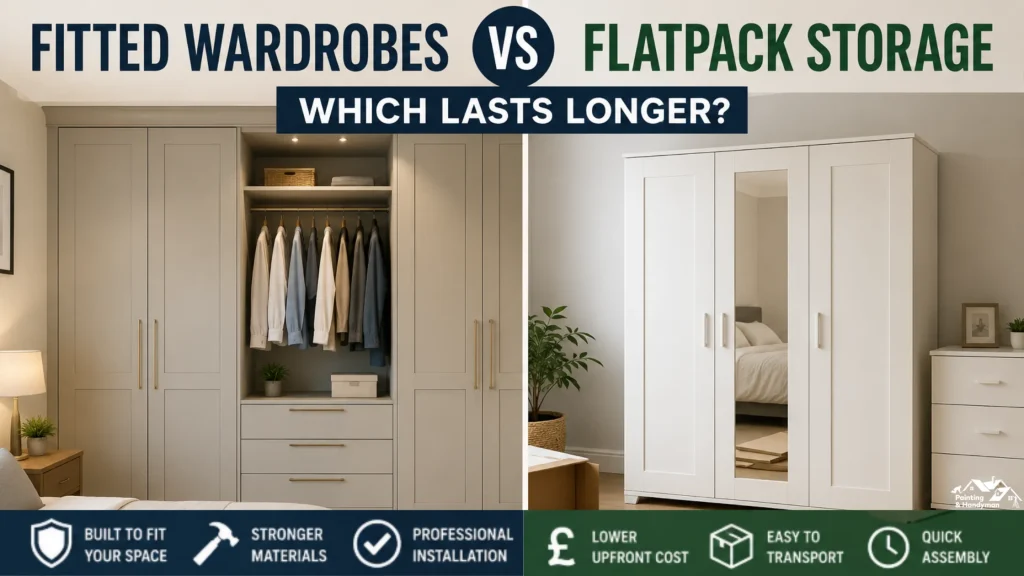
You’ve moved into a London home and need more bedroom storage. Should you buy a flatpack wardrobe, or invest in fitted storage that is made around the room?
The cheaper option may look attractive at first, but the better choice depends on how long you plan to stay, the shape of your room, the materials used and how well the furniture is installed.
A well-made and properly installed fitted wardrobe can have a longer useful life than a low-cost flatpack system, but there is no fixed lifespan for either option.
Material quality, hardware, installation, moisture, everyday use and whether the furniture is repeatedly dismantled can all affect durability. Flatpack storage can be a practical lower-cost choice, while fitted wardrobes offer better use of awkward spaces and greater design flexibility.
Fitted Wardrobes vs Flatpack Storage: What’s the Difference?
A fitted wardrobe is designed around a particular room or available space. It may be built from modular components or made largely to measure, then fitted into the room by a professional.
Flatpack storage is supplied as separate panels and fittings that are assembled after delivery. It is normally manufactured to standard dimensions rather than the exact measurements of your room.
Both can provide useful storage. The main difference is how they are designed, constructed, installed and used.
There is also a middle option: a modular storage system professionally assembled and fitted. This can provide some of the advantages of fitted storage without requiring a fully bespoke build.
What Determines How Long a Wardrobe Lasts?
It is tempting to compare fitted and flatpack furniture by looking only at the label.
That can be misleading.
A fitted wardrobe is not automatically made from better materials, and a flatpack wardrobe is not automatically poorly made. The quality of the individual product matters.
Here are the main factors that affect durability.
1. Board and Material Quality
The material used for the carcass, doors and shelves has a major effect on how the furniture performs.
Common materials include:
- Particleboard or chipboard – widely used in affordable furniture and available in different grades and finishes.
- MDF – a dense engineered wood product often used for doors, panels and decorative components.
- Plywood – made from layers of wood veneer and commonly valued for its strength and dimensional stability.
- Solid timber – used in some bespoke furniture, although it is less common for complete modern wardrobe systems.
There is no simple rule that says MDF or plywood is always better than particleboard. The board grade, thickness, edge treatment, hardware and construction method all matter.
For example, a well-designed wardrobe made from good-quality engineered board can perform very well, while a poorly designed unit made from a more expensive material can still develop problems.
Quick Tip
Don’t choose a wardrobe simply because it is described as “fitted” or “bespoke.” Ask what materials are being used, how the panels are joined, what hardware is included and how the unit will be secured..
2. How the Storage Is Installed
Installation can have a major effect on the long-term performance of storage furniture.
A freestanding flatpack wardrobe depends on its own structure and the quality of its assembly. A fitted system is designed to work with the room and is normally secured using fixings suitable for the building and installation.
The exact fixing method depends on:
- Wall construction
- Floor type
- Furniture design
- Weight
- Manufacturer instructions
- The layout of the room
A good installation should leave the furniture stable, level and properly supported.
Tall furniture should also be secured appropriately where required. Local authority home-safety guidance recommends securing tall or heavy furniture to reduce the risk of tipping, particularly where children may be present.
3. Assembly Quality Matters
Flatpack furniture is not necessarily short-lived.
Poor assembly, however, can cause problems much sooner than expected.
Common issues include:
- Panels being forced together when they are not correctly aligned.
- Fixings being overtightened and damaging the board.
- Important brackets or supports being left out.
- The unit being assembled on an uneven surface.
- Doors and hinges not being correctly adjusted.
- The furniture being moved and rebuilt several times.
A careful assembly can make a significant difference.
If you are not confident assembling a large wardrobe, professional installation can be a practical option. It can also help with wall fixing and levelling where appropriate.
Paint & Handy’s handyman services in London can be relevant when a storage project involves professional furniture assembly or other general installation work.
4. Fitted Storage Makes Better Use of Awkward Spaces
This is one of the biggest advantages of fitted wardrobes.
London homes come in many shapes and sizes. Some properties have:
- Alcoves
- Chimney breasts
- Sloping ceilings
- Narrow bedrooms
- Uneven walls
- Unusual corners
- Limited floor space
A standard flatpack wardrobe is designed around fixed dimensions.
A fitted storage system can be designed around the actual room measurements.
For example, imagine a bedroom with a chimney breast between two alcoves. Two standard wardrobes may leave unused gaps on either side.
A fitted design can use those spaces for shelves, drawers, hanging rails or cupboards.
That does not necessarily make the fitted option more durable, but it can make the available floor and wall space much more useful.
London Homes and Older Properties
London has a large amount of older housing.
The London Assembly Research Unit reported in 2024 that 27.6% of London’s homes were built before 1919, while a further 22.3% were built between 1919 and 1944. Together, these groups account for about half of the capital’s housing stock.
Older properties can have room layouts that differ from modern standardised spaces.
You may find:
- Deep alcoves
- Chimney breasts
- Uneven walls
- Non-standard ceiling heights
- Narrow recesses
- Converted rooms
This is where fitted storage can offer a practical advantage.
Rather than trying to make a standard wardrobe work around the room, the storage can be designed around the available space.
Example
A Victorian bedroom may have a chimney breast that creates two narrow recesses.
A standard wardrobe may not fit either recess properly.
A made-to-measure storage design can use those recesses for separate hanging or shelving areas while keeping the central floor area clear.
Moisture Can Affect Wardrobe Durability
Material choice is only part of the picture.
The environment around the furniture matters too.
Moisture and poor ventilation can cause problems for both furniture and the room itself.
Large wardrobes placed tightly against cold external walls can restrict air movement and contribute to condensation behind the furniture. Local authority housing guidance recommends leaving space for air circulation and avoiding overfilling wardrobes and cupboards.
This is especially worth considering in bedrooms where ventilation is limited.
Good practice includes:
- Leave suitable space for air circulation where possible.
- Avoid overfilling wardrobes.
- Watch for condensation behind large furniture.
- Deal with leaks or damp promptly.
- Follow the furniture manufacturer’s installation guidance.
If you see mould or persistent damp behind a wardrobe, don’t simply replace the furniture. The moisture source should also be investigated.
Fitted Wardrobes vs Flatpack: Cost, Flexibility and Durability
There is no single price that applies to every wardrobe.
The cost depends on the size, material, design, doors, internal fittings, finish, installation and location.
Instead of using unsupported fixed price ranges, it is more useful to compare the two options by the factors that affect the buying decision.
| Factor | Flatpack Storage | Fitted Wardrobe |
| Initial cost | Usually lower | Usually higher |
| Room fit | Standard dimensions | Designed around the space |
| Awkward areas | Limited | Strong advantage |
| Customisation | Usually limited | High |
| Installation | Self-assembly or professional assembly | Usually professional installation |
| Portability | Easier to move | Generally less portable |
| Storage efficiency | Depends on room and unit size | Can use more of the available space |
| Repair | Depends on parts and construction | Depends on design and materials |
| Long-term durability | Varies by product and use | Varies by materials and installation |
| Best suited to | Budget or flexible storage | Long-term, space-specific storage |
The important point is that price alone does not tell you how long the furniture will last.
Which One Should You Choose?
Flatpack Storage May Suit You If:
A flatpack wardrobe can make sense when:
- You have a limited initial budget.
- You are renting.
- You may move home in the near future.
- Your bedroom has standard dimensions.
- You want furniture that can potentially be moved.
- You need storage quickly.
For a simple room with plenty of available space, there may be little reason to pay for a fully fitted solution.
A Fitted Wardrobe May Suit You If:
Fitted storage may be worth considering when:
- You own your home.
- You plan to stay for several years.
- Your room has awkward dimensions.
- You want to use an alcove.
- You have a sloping ceiling.
- You need storage designed around a chimney breast.
- You want to use more of the available wall space.
- You want a particular combination of shelves, drawers and hanging space.
The biggest benefit is often space efficiency, rather than simply durability.
What About Professionally Installed Flatpack Storage?
There is another option between the two.
You can buy a modular or flatpack storage system and have it professionally assembled and installed.
This can help if:
- You like the product’s design.
- The price fits your budget.
- You want professional assembly.
- You need the unit levelled correctly.
- You need suitable wall fixing.
- You do not want to assemble a large wardrobe yourself.
It will still have the dimensions and construction of the original product, so professional installation cannot turn a standard flatpack unit into a bespoke wardrobe.
But careful assembly and suitable installation can help you get the best performance from the product.
Which Is Easier to Repair?
This depends on how the furniture is constructed.
With a flatpack wardrobe, replacement parts may depend on the manufacturer still supplying compatible panels, hinges, runners or fixings.
A fitted wardrobe can sometimes be easier to modify because it was designed around the property. A carpenter may be able to replace or alter individual components, depending on how the unit was constructed.
For example, if you need an additional shelf or a replacement door, a bespoke storage system may offer more flexibility.
That does not mean every fitted wardrobe is easier to repair. The availability of materials, hardware and the original construction all matter.
How to Make Either Type of Wardrobe Last Longer
You don’t have to choose fitted storage to get good long-term performance.
These simple habits can help protect either option:
1. Keep the room dry
Deal with leaks and persistent condensation promptly.
2. Avoid overloading shelves
Follow the manufacturer’s weight limits where they are provided.
3. Don’t force doors or drawers
If a door starts rubbing or a drawer becomes difficult to open, find out why rather than repeatedly forcing it.
4. Check hinges and runners
Loose or damaged hardware can affect the rest of the furniture.
5. Avoid repeated dismantling
Flatpack furniture is designed for assembly, but repeated disassembly and rebuilding can affect joints and fixings depending on the product.
6. Keep furniture stable
Follow the manufacturer’s instructions for securing tall furniture.
7. Maintain ventilation
Don’t block ventilation around wardrobes, particularly where condensation is already a concern.
Do Fitted Wardrobes Add Property Value?
It is better not to assume that a fitted wardrobe will automatically increase a property’s sale price.
The value to a buyer depends on the property, the quality of the installation, the design and whether the storage suits the room.
Good fitted storage can be attractive because it:
- Uses awkward spaces efficiently.
- Provides dedicated storage.
- Creates a tidy appearance.
- Can reduce the need for additional freestanding furniture.
Poorly designed or dated furniture can have the opposite effect.
The safest approach is to think about function, quality and suitability for the room, rather than treating fitted storage as a guaranteed property investment.
Fitted Wardrobes vs Flatpack: Which Lasts Longer?
There is no reliable universal number of years that applies to every fitted or flatpack wardrobe.
A well-built fitted wardrobe can have a long useful life, particularly when quality materials, suitable hardware and professional installation are used.
A good-quality flatpack wardrobe can also provide years of useful service, particularly when it is assembled correctly, kept dry and used within its intended limits.
So the better question is not simply:
Which type lasts longer?
It is:
Which storage system has the right materials, construction, installation and maintenance for your home?
If you are staying long-term and have an awkward London bedroom, fitted storage may offer the better overall solution.
If you need affordable, flexible furniture for a standard room, flatpack storage may be the more practical choice.
Final Verdict
Fitted wardrobes are not automatically more durable than flatpack storage, but a well-designed fitted system can offer strong long-term performance while making better use of an unusual room.
Flatpack storage remains a sensible choice for renters, standard bedrooms and buyers who want lower upfront costs or greater portability.
For London homeowners, the shape of the room may be just as important as the furniture itself. Alcoves, chimney breasts, sloping ceilings and uneven walls can make standard storage less efficient.
Before choosing, consider:
- How long will you stay in the property?
- How much storage do you actually need?
- Does the room have awkward spaces?
- What materials are being used?
- How will the furniture be installed?
- Will the furniture need to be moved later?
Those answers will tell you more than a simple fitted-versus-flatpack label.
Ready to Choose the Right Storage for Your Space?
Whether you need a flatpack wardrobe professionally assembled or a storage solution designed around an awkward bedroom, the right installation can make a noticeable difference to how the furniture looks and performs.
Paint & Handy provides carpentry services in London, including custom furniture and storage-related carpentry work.
If you already have a flatpack unit that needs professional assembly, handyman services in London may also be suitable.
For a storage project designed around your room, request a quote from Paint & Handy and discuss your requirements with the team.
Frequently Asked Questions
1. Do flatpack wardrobes fall apart quickly?
Not necessarily. Quality varies between products. A flatpack wardrobe that is correctly assembled, kept dry and used within its intended limits can provide years of service. Repeated dismantling, excessive loads, moisture or damaged components can shorten its useful life.
2. Are fitted wardrobes worth the extra cost?
They can be, particularly for homeowners who plan to stay for several years or have an awkward room layout. The main benefits are space efficiency, customization and a design that can work around features such as alcoves and chimney breasts.
3. Can a fitted wardrobe fit a room with a sloping ceiling or alcove?
Yes. One of the main advantages of fitted storage is that it can be designed around the available space. The exact design will depend on the room measurements, ceiling shape, walls and the type of storage required.
4. Is flatpack furniture suitable for London flats?
Yes. Flatpack furniture can work well in a standard bedroom, particularly when budget and portability matter. The room should be measured carefully before buying, especially where access, alcoves or unusual wall dimensions are involved.
5. How much does a fitted wardrobe cost in London?
In London, a professionally installed fitted wardrobe can typically cost around £2,500–£7,000+, depending on the size, materials, internal storage, doors and finish. Larger bespoke or premium projects can cost £10,000 or more. For example, Which? reported 2026 prices of about £3,400 for a 3-door bespoke wardrobe and £5,600 for a 4-door bespoke wardrobe, including professional installation and VAT.
6. Can I make a flatpack wardrobe last longer?
Yes. Follow the manufacturer’s assembly instructions, use suitable fixings where required, avoid overloading shelves, protect the furniture from moisture and deal with loose hinges or runners before they become larger problems.
7. Should wardrobes be fixed to the wall?
Follow the manufacturer’s instructions and use suitable anti-tip or fixing systems for tall furniture where required. Securing tall furniture can reduce the risk of tipping, particularly in homes where children may be present.
