
Have you noticed a thin crack running across your plaster wall and wondered whether it is just cosmetic or something you should worry about?
Small cracks are common in homes and do not automatically mean there is a serious structural problem. They can develop as plaster dries and shrinks, as buildings move slightly over time, because of moisture, or because the plaster has lost its bond with the surface behind it.
The key is to identify what type of crack you have before repairing it.
Quick Answer
Plaster walls can crack because of normal shrinkage, minor building movement, moisture, poor plaster application, ageing materials or movement in the structure behind the plaster.
Fine surface cracks are often suitable for local repair, but cracks that are widening, recurring, associated with movement, or accompanied by bulging or other building defects should be assessed before simply filling and painting them.
What Causes Plaster Walls to Crack?
A plaster crack is a visible break in the plaster surface. The crack may be limited to the decorative finish, or it may reflect movement or deterioration underneath.
Common causes include:
- Plaster shrinkage while drying
- Minor building movement
- Movement between different materials
- Poor plaster application
- Moisture or damp
- Ageing plaster
- Movement or deterioration of timber or other supporting materials
- Structural movement in some cases
The appearance, location and progression of the crack can help you decide what to do next.
Types of Plaster Cracks and What They Can Mean
Not every crack needs the same repair.
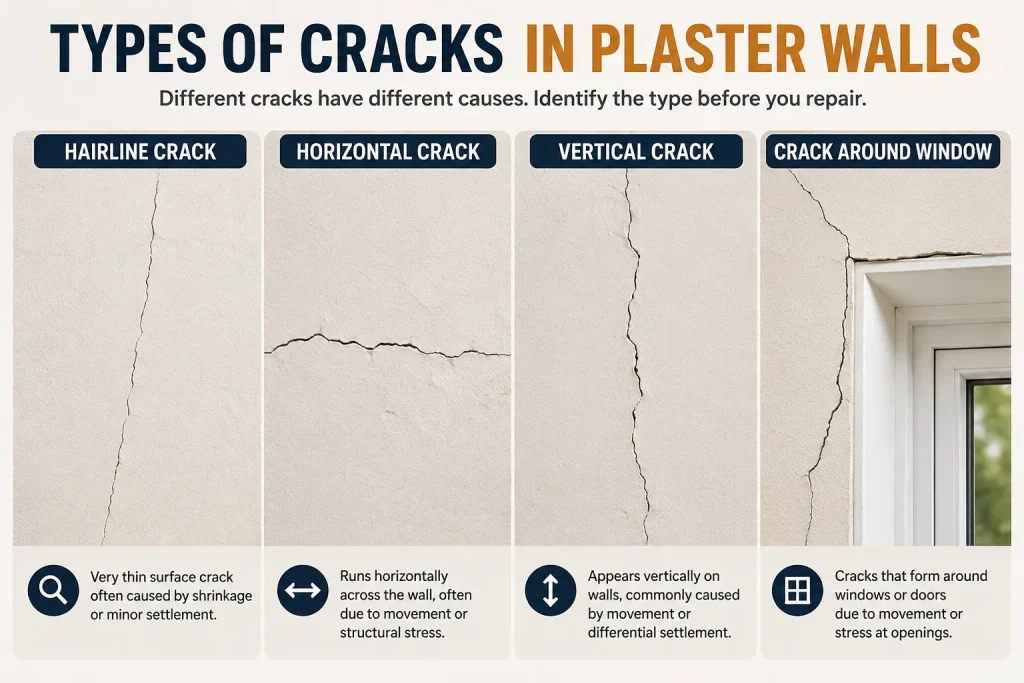
Quick comparison
| Crack type | Common appearance | Possible cause | Typical next step |
| Hairline crack | Very thin surface line | Shrinkage or minor movement | Fill and redecorate if stable |
| Crazing | Fine network of small cracks | Surface plaster or finish | Repair surface after identifying cause |
| Crack at a joint | Runs along a plasterboard joint | Joint movement or poor finishing | Re-tape or repair joint |
| Crack around a door/window | Starts near an opening | Movement or stress around opening | Monitor and assess if recurring |
| Vertical or horizontal crack | Longer, defined line | Movement, joints or substrate | Assess location and progression |
| Wide or growing crack | Increasing gap | Possible significant movement | Seek professional assessment |
| Crack with bulging plaster | Surface may feel loose | Loss of adhesion or moisture | Repair loose plaster and investigate cause |
This table is a guide, not a diagnosis. A crack’s width alone does not always tell you its cause.
1. Hairline Cracks from Plaster Shrinkage
One of the simplest reasons plaster cracks is shrinkage.
As some plaster and other building materials dry, they can lose moisture and change size. This can create fine cracks on the surface.
Hairline cracks are often:
- Very narrow
- Short
- Superficial
- More visible after painting
- Stable over time
Small cracks can sometimes be dealt with during normal wall preparation before decorating.
However, if a crack keeps returning after repair, don’t keep filling it without considering why it is moving.
Guidance from the New Forest National Park Authority notes that shrinkage and poor application can contribute to cracking and deterioration of plaster and render.
2. Minor Building Movement
Buildings are not completely rigid.
Different materials can respond differently to changes in temperature, moisture and movement. Small amounts of movement can therefore produce cracks in plaster without indicating a major structural defect.
For example, a plastered wall may develop a fine crack where two different materials meet or where a building has experienced minor movement over time.
Some housing guidance also notes that minor movement can cause plaster cracks and that recurring cracks should be inspected.
What should you look for?
Ask yourself:
- Is the crack new?
- Has it changed?
- Is it getting wider?
- Has it appeared in the same place before?
- Is there a similar crack outside?
- Are doors or windows becoming difficult to open?
- Is there any associated damp or bulging plaster?
These details provide useful context before deciding on a repair.
3. Cracks Around Doors and Windows
Cracks around doors and windows deserve a closer look because openings interrupt the wall structure.
A crack may appear:
- From the corner of a window
- From the corner of a door opening
- Above a lintel
- Along the edge of a frame
A small, stable crack may still be a plaster or finishing issue.
However, new or expanding cracks around openings, especially when accompanied by sticking doors or windows, deserve professional assessment.
RICS guidance on subsidence lists new or expanding cracks in plasterwork, new external brickwork cracks, sticking doors or windows and other changes as signs that may warrant specialist help. It also notes that sudden cracks wider than 3mm can be a reason for concern.
This does not mean that every crack wider than 3mm indicates subsidence. The cause needs to be assessed in context.
4. Cracks Caused by Poor Plaster Application
The way plaster is applied can affect how it performs later.
Problems can occur when:
- Plaster coats are applied too thickly
- Different coats do not bond correctly
- The background is not prepared properly
- Materials with different strengths are used together without suitable preparation
- The surface dries too quickly
- The plaster loses its bond with the background
The New Forest National Park Authority identifies excessive plaster thickness, poor suction control and unsuitable coat combinations among causes of cracking, crazing and separation.
If cracking appeared soon after a plastering job, the application and preparation should be considered rather than assuming the wall itself is moving.
5. Damp and Moisture Can Damage Plaster
Moisture is another reason plaster may deteriorate.
Water can enter a property through different routes, including:
- Leaking pipes
- Roof defects
- Damaged external walls
- Defective gutters or rainwater goods
- Ground moisture
- Condensation
GOV.UK distinguishes between condensation damp, penetrating damp, rising damp and other forms of moisture entering a building. Condensation occurs when moisture in indoor air reaches colder surfaces, while penetrating damp can result from defects in walls, roofs, windows or floors.
Moisture can lead to:
- Soft plaster
- Bubbling paint
- Flaking surfaces
- Staining
- Mould
- Loose plaster
- Cracking
Don’t just fill a damp-related crack
If moisture is causing the damage, filling the crack without dealing with the source may only provide a temporary cosmetic result.
Find and address the moisture problem first. The wall can then be allowed to dry before damaged plaster is repaired.
6. Old Plaster Can Lose Its Bond
Older homes may contain traditional plaster systems that behave differently from modern plasterboard and gypsum-based finishes.
Historic England advises that historic lime plaster should not be removed without good reason. Older lime plaster can soften when wet and harden again when dry, while deterioration can occur when the plaster loses its connection with underlying laths.
This matters in older London properties.
If you live in a period property, don’t automatically replace old plaster with a modern material simply because it has cracked.
The appropriate repair depends on:
- The age of the building
- Existing plaster type
- Wall construction
- Moisture conditions
- Extent of damage
- Previous repairs
Historic England also advises using materials that are suitable for the way an older property was built, particularly where historic fabric is involved.
Why Plaster Cracks Can Be Common in Older London Homes
London has a large stock of older properties.
The London Assembly Research Unit’s 2024 housing-stock analysis found that 27.6% of London’s homes were built before 1919, while another 22.3% were built between 1919 and 1944. Together, those periods account for almost half of the capital’s homes.
Older London homes can have:
- Traditional plaster
- Lath and plaster ceilings
- Chimney breasts
- Period extensions
- Converted rooms
- Previous alterations
- Different materials joined together
This does not mean an older home will necessarily have cracked walls.
It simply means the construction history matters when deciding how to repair the plaster.
For example, repairing a crack in a modern plasterboard wall may require a different approach from repairing damaged lime plaster in a Victorian property.
7. Seasonal Changes Can Affect Cracks
Some cracks can become more noticeable at different times of the year.
Buildings and their materials respond to changes in:
- Temperature
- Humidity
- Moisture
- Ground conditions
RICS explains that building movement and changes in ground conditions can contribute to cracking, while some cracks may need to be measured and monitored over time when movement is suspected.
If you notice that a crack appears to change with the seasons, record its location and appearance rather than repeatedly filling it.
A professional can then consider whether the movement is related to the plaster surface or something further behind it.
How to Tell If a Plaster Crack Is Minor or Needs Attention
You cannot diagnose the cause of a crack from a photograph alone.
However, these signs can help you decide what to do next.
Often suitable for routine plaster repair
- Very fine hairline crack
- Small surface crack
- No damp
- No loose or bulging plaster
- No noticeable change over time
- No other signs of building movement
Worth getting assessed
- Crack is getting wider
- Crack repeatedly returns
- Crack appeared suddenly
- Crack extends through plaster and masonry
- Crack appears on both internal and external surfaces
- Doors or windows have started sticking
- Plaster is bulging or separating
- There are damp patches nearby
- Several new cracks have appeared at once
RICS identifies new or expanding cracks, sticking doors and windows, and related changes as signs that may warrant specialist investigation when subsidence is a concern.
Don’t simply fill a crack that keeps coming back.
If a crack is repeatedly reopening, growing, accompanied by bulging plaster, or linked with damp or other building changes, find out what is causing it before carrying out another cosmetic repair.
How to Fix Small Plaster Cracks
If the crack is clearly superficial and the surrounding plaster is sound, a local repair may be suitable.
Step 1: Inspect the area
Look closely at the crack.
Check for:
- Loose plaster
- Damp
- Mould
- Flaking paint
- Bulging
- Signs of movement
If you find any of these issues, investigate the cause before repairing the surface.
Step 2: Prepare the crack
For a small stable crack, remove loose material around the damaged area.
Do not make the crack unnecessarily large.
The aim is to create a sound surface for the repair material.
Step 3: Apply suitable filler
Use a suitable product for the type and depth of repair.
For a very fine surface crack, a suitable interior filler may be enough.
Deeper or wider damage may require a different repair method.
Step 4: Allow it to dry
Follow the product manufacturer’s drying instructions.
Do not rush the next stage.
Step 5: Sand the repaired area
Once dry, lightly sand the repair so that the surface is level with the surrounding wall.
Avoid removing sound plaster around the repair.
Step 6: Prime where needed
A repaired or highly absorbent surface may need suitable preparation before painting.
Follow the instructions for the filler, primer and paint being used.
Step 7: Repaint the wall
Use a suitable interior paint and apply it according to the manufacturer’s instructions.
If the repaired area remains visible after painting, the issue may be with the surface preparation rather than the paint itself.
When Does a Plaster Crack Need More Than Filling?
A filler is not a solution for every type of wall damage.
You may need more extensive repair if:
The plaster is loose
If the plaster has lost its bond with the backing, filling the visible crack will not restore the damaged area.
Historic England notes that de-bonded historic plaster may require specialist repair or local removal and reinstatement with suitable materials.
The wall has damp
Repair the moisture problem before replacing damaged plaster.
The crack keeps returning
Repeated cracking suggests that the underlying movement or surface condition needs attention.
A large area is damaged
If plaster is cracked, loose or missing across a large section, local filling may produce an uneven finish.
There are possible structural signs
If the crack is accompanied by movement, external masonry cracking, sticking doors or windows, or other changes, seek appropriate professional advice before decorating over it.
Plaster Repair vs Replastering: Which Do You Need?
You do not always need to replaster an entire wall.
| Situation | Likely approach |
| Small stable hairline crack | Local filling |
| Several small surface cracks | Surface preparation and local repair |
| Damaged plaster around a small area | Local plaster repair |
| Loose plaster | Remove affected material and repair |
| Widespread damaged plaster | Partial or full replastering |
| Damp-damaged plaster | Address moisture source, then repair |
| Historic lime plaster | Use materials suitable for the existing building |
| Recurring structural-looking crack | Assessment before cosmetic repair |
The right approach depends on the condition of the wall rather than the size of the crack alone.
Should You Paint Over Cracked Plaster?
Not before repairing the underlying surface.
Painting over a crack may temporarily hide it, but the crack can become visible again as the wall continues to move or the damaged surface changes.
A better sequence is:
Inspect → identify the cause → repair → prepare → prime if needed → paint
Paint & Handy’s painting and decoration service includes plastering and wall repairs, making it possible to deal with surface preparation and decoration as part of the same project.
How Much Does Plaster Crack Repair Cost in London?
There is no single price for repairing cracked plaster.
The cost depends on:
- Crack size
- Number of cracks
- Wall condition
- Whether plaster is loose
- Whether damp is involved
- Repair materials
- Surface preparation
- Painting requirements
- Access
- Whether the whole wall needs replastering
A small isolated crack may require much less work than a wall with loose plaster, damp damage or repeated movement.
For this reason, a project-specific assessment is more useful than relying on a generic online price.
Paint & Handy offers quotes for painting, decorating and related home improvement work through its booking system.
How to Prevent Plaster Cracks From Returning
You cannot prevent every crack.
However, good maintenance can reduce avoidable problems.
Keep moisture under control
Deal with leaks, condensation and other damp sources promptly.
GOV.UK identifies poor ventilation, low wall temperatures, condensation and building defects among factors associated with damp and mould.
Deal with leaks quickly
A leaking pipe or roof can damage plaster over time.
Keep rooms ventilated
Good ventilation can help control indoor moisture.
Don’t ignore recurring cracks
If the same crack repeatedly appears, find out why.
Use suitable repair materials
This is especially important in older properties.
Historic England advises choosing repair materials that are compatible with the existing building.
Prepare walls properly before decorating
Good preparation gives repaired areas a better chance of blending into the surrounding surface.
Plaster Cracks in London Homes: What Should You Do?
If you notice a crack, don’t panic.
Start by checking:
- How wide is it?
- Where is it located?
- Is the plaster loose or bulging?
- Is there damp nearby?
- Has the crack changed?
- Has it appeared somewhere else too?
- Are doors or windows sticking?
- Is there a similar crack on the outside wall?
A small, stable surface crack may simply need local repair.
A recurring or changing crack needs more attention.
If you are unsure about the cause, getting the wall assessed before repairing it can prevent you from spending money on a cosmetic fix that does not last.
Get Help With Cracked Plaster in London
A cracked wall does not always require major work. The right repair depends on why the crack appeared, how much the plaster is damaged and whether the problem is still changing.
For small, stable cracks, proper preparation and local repair may be enough. For loose plaster, damp-related damage or recurring cracks, the cause should be addressed before the wall is redecorated.
Paint & Handy provides plastering, wall repair, painting and decorating services across London, including residential properties and period homes.
View Paint & Handy’s Painting & Decoration Services
If your wall needs repair before painting, you can also request a quote from Paint & Handy with details of the damage and the work required.
Frequently Asked Questions
1. Are cracks in plaster walls normal?
Small cracks can occur as plaster dries, materials change with temperature and moisture, or buildings experience minor movement. A crack is not automatically a sign of a serious structural problem. Recurring, widening or associated cracks should be assessed.
2. What is the most common cause of cracks in plaster?
There is no single cause for every crack. Fine cracks can result from plaster shrinkage or minor movement, while moisture, poor application, ageing materials and movement behind the plaster can also cause damage.
3. When should I worry about a crack in my plaster wall?
Pay closer attention when a crack is new and expanding, repeatedly returns, is accompanied by bulging plaster, damp, external cracking, or sticking doors and windows. RICS recommends specialist help when these signs raise concerns about possible subsidence.
4. Can I just fill a crack in a plaster wall?
A small, stable surface crack can often be repaired with suitable filler after proper preparation. If the crack keeps returning or the plaster is loose, damp or moving, identify the underlying problem before carrying out another cosmetic repair.
5. Why do plaster walls crack in older London homes?
Older London properties can contain traditional plaster, older wall construction and areas that have been altered over the years. London also has a large stock of pre-1945 housing. These factors mean the construction and previous repair history should be considered when dealing with cracked plaster.
6. Can damp cause plaster to crack?
Yes. Moisture can contribute to defective or deteriorating plaster. GOV.UK identifies condensation, penetrating damp, rising damp and leaks as different moisture-related problems that can affect homes. The source of moisture should be addressed before damaged plaster is repaired.
7. Should I replaster a whole wall because of one crack?
Not necessarily. A small, stable crack may only need a local repair. Full or partial replastering may be appropriate when plaster is loose, extensively damaged, badly deteriorated or affected by a wider surface problem.
8. Can I paint directly over a repaired plaster crack?
It is better to repair and prepare the surface first. Once the filler or plaster repair has dried and been prepared correctly, you can apply suitable paint. Painting directly over an untreated crack may leave the defect visible or allow it to reappear.
